WordPress Development Agency in Somerset
Blunt Notion is based in Yeovil and works with clients across Somerset, the UK and overseas. We handle the thinking, interface design and development together, so what gets approved can actually be built and what gets built remains practical to manage.
No compulsory hosting. No mystery ownership. No pile of plugins pretending to be a development strategy.
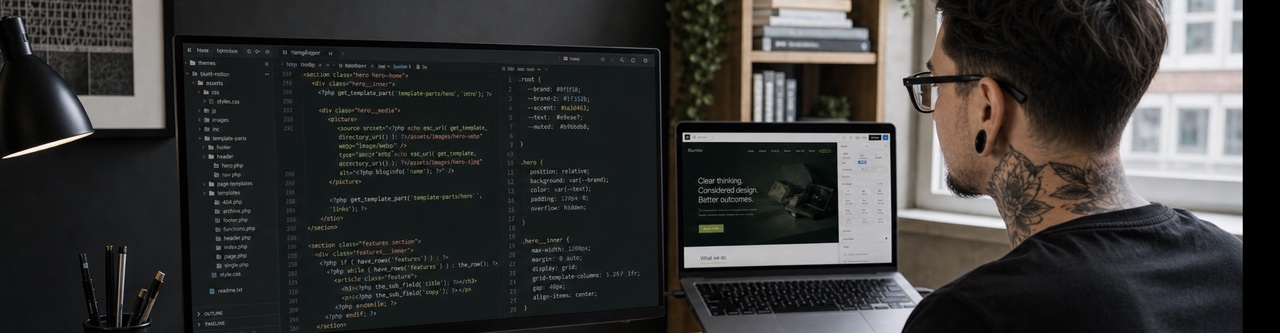

WordPress is rarely the problem. The way it has been built usually is.
WordPress can run a straightforward service website, a large publishing platform, a membership system or an online shop. It is established, flexible and open source. Your business is not tied to a closed platform or forced to rebuild everything because a supplier changes direction.
It can also be slow, awkward and fragile when a generic theme, a heavy page builder and too many overlapping plugins are stacked together without a plan. That is not an unavoidable WordPress problem. It is a build problem.
We start with the content, users and jobs the website needs to handle. From there we define the templates, content types, editing controls, integrations and technical boundaries before development gets expensive. The front end is built around the approved design; the administration area is shaped around the people who will actually use it.
Our normal approach is a custom-coded WordPress theme. We can still inherit Elementor and other established builders, improve an existing theme or use a different approach where replacing it would waste time and budget. “Custom” is not a religion. It is the right answer when the requirement justifies it.

Scope and content architecture.
Development begins before somebody opens a code editor. We establish what the website publishes, which pages and content types need to relate to one another, what visitors must be able to do and what the client needs to manage internally.
That might mean services, team members, projects, locations, resources, products or something specific to the business. Defining the structure properly avoids forcing every piece of content into a generic page and makes future expansion far less painful.
For an existing website, we also review its URLs, content, plugins, integrations and search visibility. Useful structure is retained. Accidental complexity is not preserved merely because it already exists.
Custom theme and editor development.
The approved interface is developed into a responsive WordPress theme rather than approximated with the nearest available template. Reusable components are coded once and used consistently, which keeps the front end leaner and makes later changes more predictable.
Inside WordPress, editors get controls that match the content they are responsible for. A project entry should ask for project information. A team profile should ask for team information. Page blocks should provide useful flexibility without exposing every possible design decision.
The aim is not to remove control. It is to give the right control to the right person without making it easy to quietly dismantle the design.
Functionality and integrations.
WordPress often needs to work with other systems: forms, email platforms, customer databases, payment providers, booking tools, maps, search, gated content or third-party data. We decide whether a maintained plugin is sufficient, an existing tool needs extending or custom development is justified.
Installing a plugin is not automatically bad, and writing custom code is not automatically clever. The sensible choice depends on reliability, security, support, cost and how specific the requirement is.
WooCommerce can be used for suitable ecommerce requirements. If Shopify is the better platform for the business, catalogue and operating model, we will recommend Shopify instead of forcing the project into WordPress.
Testing, launch and handover.
We test throughout development and again before launch across relevant screen sizes and browsers. Content, forms, navigation, interactive behaviour, accessibility, redirects and tracking are checked as part of the actual build—not left for the client to discover after handover.
Existing websites are migrated with their URLs and search history in mind. No migration is risk-free, but mapping redirects, checking indexation and preserving useful content is considerably safer than changing everything and hoping Google works it out.
Before launch is complete, we agree hosting, backups, maintenance, training and ownership. Hosting and ongoing support are available, but neither is compulsory. The client owns the website and project code.

What does a custom WordPress build actually include?
The scope should reflect the job. A focused service website does not require the same technical work as a membership platform, a content-heavy publication or a shop connected to several business systems.
Depending on the project, a WordPress build can include:
- technical discovery and content modelling;
- review of an existing WordPress installation;
- custom post types, taxonomies and content relationships;
- custom theme and responsive front-end development;
- tailored Gutenberg blocks and editor controls;
- forms, search, filtering and gated content;
- third-party API and CRM integrations;
- WooCommerce configuration or customisation;
- content migration and URL redirect planning;
- performance and Core Web Vitals work;
- technical and on-page SEO foundations;
- structured-data implementation where relevant;
- accessibility, browser and device testing;
- analytics and Search Console migration or setup;
- deployment, training and documented handover;
- managed hosting, maintenance and ongoing development.
We do not add every possible feature to make a proposal look impressive. Anything included should solve a requirement, reduce risk or make the website easier to operate.

The theme is only one part of a useful WordPress website.
Design, development, search structure and ongoing technical care affect one another. We keep the disciplines clear, but we do not treat them as unrelated jobs handed between people who never speak.
-

Website design
Discovery, sitemaps, user journeys and original responsive interfaces created before the WordPress theme is built.
-
Website development
Front-end and back-end development for functionality, data, integrations and requirements beyond a standard content website.
-
WordPress SEO
Technical structure, indexation, templates, internal linking and content optimisation for established WordPress websites.
-
SEO
Wider technical, on-page and local SEO strategy when the job extends beyond the WordPress platform itself.


When WordPress is the right tool, and when it isn’t.
WordPress is a strong fit when the website revolves around structured content, needs a tailored publishing experience, must support search visibility and is likely to change over time. It works particularly well for service businesses, organisations, publishers, membership projects and content-led platforms.
It may be the wrong answer when a specialist hosted platform already handles the core requirement better, when the business does not want responsibility for updates and maintenance, or when the budget only supports a very small standardised site. Shopify, a dedicated application or an existing system may be more sensible.
We also work with inherited WordPress websites. Sometimes a careful technical cleanup, new templates or removal of unnecessary plugins is enough. Sometimes the theme and editor have become so restrictive that a rebuild costs less than another year of workarounds.
The recommendation should follow the business, the people maintaining the site, the deadline and the available budget. Selling WordPress is not useful if WordPress is not the right answer.
Recent
Work
-

Geo-Design
Branding, CMS, Hosting & Maintenance, SEO, Web Design, Web Development, WordPress
Geotechnical Consultancy, Rock Engineering
-
Animal Control Officers
Branding, CMS, Content Creation, Hosting & Maintenance, SEO, Web Design, Web Development, WordPress
Animal Control, Dog Handling
-
Valinor Intelligence
Branding, CMS, Content Creation, Graphics Design, SEO, Web Design, Web Development, WordPress
Open Source Intelligence
-
CK Roofing Somerset
Branding, CMS, Content Creation, Hosting & Maintenance, SEO, Web Design, Web Development, WordPress
Construction, Roofing



A new custom WordPress website.
Suitable when the business needs a website designed and developed around a clear set of commercial, content and operational requirements.
We can handle discovery, structure, interface design, WordPress development, migration, testing and launch as one project. The scope is agreed around what the website must do rather than an arbitrary number of pages.
An inherited site or complete rebuild.
Suitable when the current WordPress site is slow, difficult to edit, unreliable, dependent on abandoned code or unable to support the next stage of the business.
We first establish what is worth retaining: content, URLs, data, integrations, search visibility and any functionality that still performs a useful job. The answer may be targeted development, a new theme or a controlled rebuild.
Ongoing development and support.
Suitable when a WordPress website needs regular technical work, maintenance, new features or a developer who can take responsibility for problems instead of passing them between plugin vendors and hosting support.
Support can include updates, backups, monitoring, troubleshooting, performance work and planned improvements. Hosting is available but not compulsory, and the arrangement should match the actual level of responsibility required.
Budget, timescale and delivery.
Cost and timescale depend on design, content, functionality, integrations, migration risk, review stages and the deadline. A focused marketing website and a custom membership or ecommerce platform should not be priced as if they are the same product.
After an initial conversation, we define the requirement and provide a scoped proposal. Larger projects can be phased when there is a useful first release. Payment stages and delivery arrangements can be discussed around the project and client.

Straight answers about commissioning WordPress development.
WordPress is familiar enough that every supplier appears to offer it. These are the questions that expose what is actually being designed, developed and handed over.
It depends on the design, number and type of templates, content structure, integrations, functionality, migration and deadline. A custom service website and a membership platform are not comparable simply because both use WordPress.
We discuss the requirement first and provide a scoped proposal. Blunt Notion does not compete with a few-hundred-pound theme installation. If a smaller first phase or an existing platform would use the available budget more sensibly, we will explain that.
Timescales depend on what must be designed, built, migrated, integrated and approved. Content readiness and feedback speed matter as much as the amount of code.
We provide a realistic delivery plan after understanding the scope. A phased launch can be considered when there is a coherent first release, but phasing is not an excuse to launch unfinished foundations.
Our normal approach is an original interface and custom-coded WordPress theme. We can work with Elementor and other established builders when inheriting a site or when that approach genuinely suits the budget, deadline and people managing it.
We do not reject a useful existing system to make the project appear more bespoke, and we do not call a purchased theme custom development.
Yes. We regularly inherit websites built by other developers or agencies. We review the theme, plugins, hosting, updates, content structure, errors and any known security or performance issues before recommending work.
Access to the hosting, WordPress administration, domain, code repository and relevant third-party accounts makes that assessment considerably more useful.
Yes, where the benefit justifies the cost. The work normally involves mapping the existing content and URLs, rebuilding the required templates and components, moving content out of builder-specific structures and testing redirects and search-critical elements.
A migration should remove a real constraint. Rebuilding solely to replace one respectable tool with another is not automatically a good use of budget.
Yes. We build the editing experience around the content your team needs to manage and provide training before handover. Approved blocks and structured fields allow ordinary changes without asking a developer to edit every sentence.
Some technical changes should still be handled by somebody who understands the build. Editing access is not the same as pretending every part of a custom website is safely changeable without consequences.
Yes. The client owns the website and project code. Hosting, maintenance and ongoing development are available, but they are not compulsory conditions of ownership.
WooCommerce can be a good fit when ecommerce needs to sit closely alongside a WordPress content platform or requires WordPress-specific functionality. The right choice depends on the catalogue, fulfilment, integrations, internal workflow and growth plans.
Where Shopify is the better operational fit, we will recommend Shopify rather than force the shop into WordPress.
A build includes sound foundations: crawlable templates, considered page structure, performance work, redirect planning, metadata controls and structured data where relevant. That is not the same as an ongoing SEO campaign.
Keyword strategy, sustained content work, local SEO and continuing optimisation can be handled through our WordPress SEO services or wider SEO service.
Yes. Managed hosting, updates, backups, monitoring and technical support can be included after launch. They are recommended where the client does not have somebody taking responsibility internally, but neither hosting nor maintenance is compulsory.
Tell us what WordPress needs to do.
Tell us about the business, the current website, the people who manage it and the problem you need to solve. If WordPress is the right foundation, we will explain the sensible next step. If it is not, we will say that too.